You can search candidates using the following ways:
- Using the field Search candidates located in the Header bar in each page of the software you can search by name, surname or e-mail of the candidate you are looking for.

- Using the Tab Search located in the side Menu > Candidates you have the opportunity to make a detailed research of the candidates of you DB.

- Basic Search
- Advanced Search
Basic Search
Within the Basic Search, you can search using the following methods:
Boolean Search: You can use the search box to perform a text search that analyzes the information available in the Profile tab of candidates (including attached CVs) and in the Comments tab.

The search box allows you to build your query using Boolean operators, a set of commands that help combine keywords in a structured way.
Note: Boolean operators must be entered in UPPERCASE.
For each search in the database, you will get a list of candidates sorted according to a match score (MATCH SCORE) based on the searched keywords, broken down as follows:- Green: 80-100%
- Yellow : 60-79%
- Orange : 40-59%
- Red : < 39%

It will also be possible to use Synonyms (which can be set manually from System Settings > Customisable fields > Synonym Management) to better search for candidates and not miss any.
- Natural Language Search (Boolean Search Assistant): within the Simple Search, the natural language search functionality is also available, designed to simplify the use of boolean search.
This feature is intended to make searching faster and easier. You no longer need to know boolean operators, as the system handles them automatically for you. This allows you to achieve more accurate results in less time, making the search accessible even to less experienced users or those unfamiliar with advanced search logic.
Using the Boolean Search Assistant button you can enter a request in natural language, which will be automatically converted into a boolean string.
You can enter your request in the text field in a simple and flexible way: you can either type it manually or use the Speech-to-Text feature, which allows you to dictate your query and automatically convert it into text. Once the request has been entered, click on "Get Boolean Query" to transform it into a structured search string. After the conversion, you can use the "Apply to Search" button to directly run the query on candidates. This button becomes active only after the conversion has been successfully completed.
- Search by Filters: allows you to use pre-set fields from the system for the candidate profile, such as your home address, professional experience, education level, etc.
In this case, the system will act as a true "filter", ie by going to select only the candidates with the required specifications without attributing them a score, as is the case for Full text search. Note: by setting the "Vacancy" filter and selecting a specific Vacancy, the system will display the candidates registered for that position.
This makes it possible to apply additional candidate filters to identify the profiles of interest. It is also possible to update the "Vacancy Status" directly from the search results list.
Advanced Search has a setup similar to Simple Search but, in addition to Boolean Search, it allows you to add filters through the Build Search Filter dropdown and use Boolean operators to create more advanced search criteria.
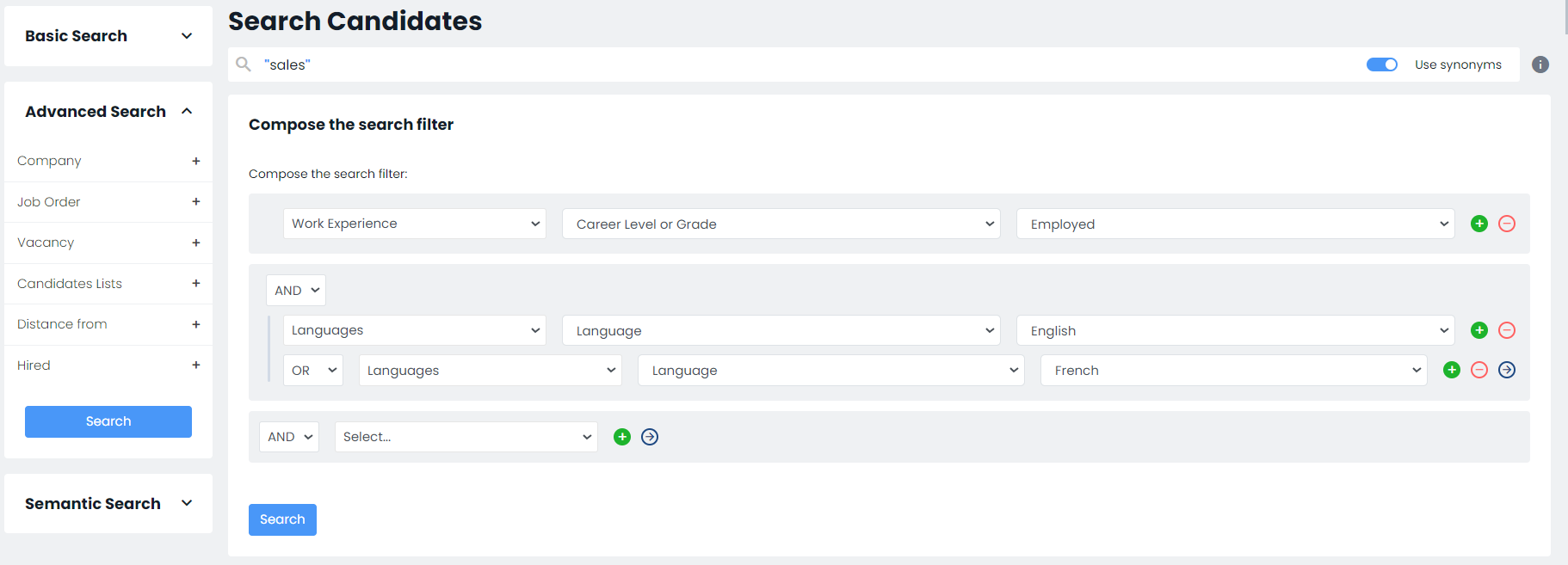
When building an advanced search, two options are available to help you create increasingly specific search conditions:
+ Add Filter
Use this option to add a new search condition at the same level as the existing ones.
-> Create Filter Group
Use this option to create a group of conditions (a subquery) enclosed in parentheses.
The available filters can be combined using logical operators such as AND and OR, allowing you to build more complex search queries.
Example
Career Level = Employed AND (Language = English OR Language = French)
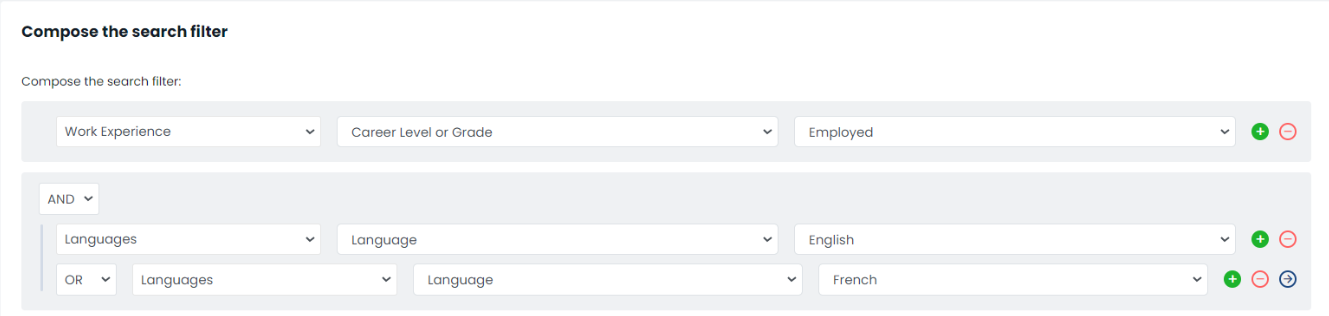
In this example, the group enclosed in parentheses is created using the Create Filter Group option and allows you to search for candidates employed who speak either English or French,
Was this article helpful?
That’s Great!
Thank you for your feedback
Sorry! We couldn't be helpful
Thank you for your feedback
Feedback sent
We appreciate your effort and will try to fix the article